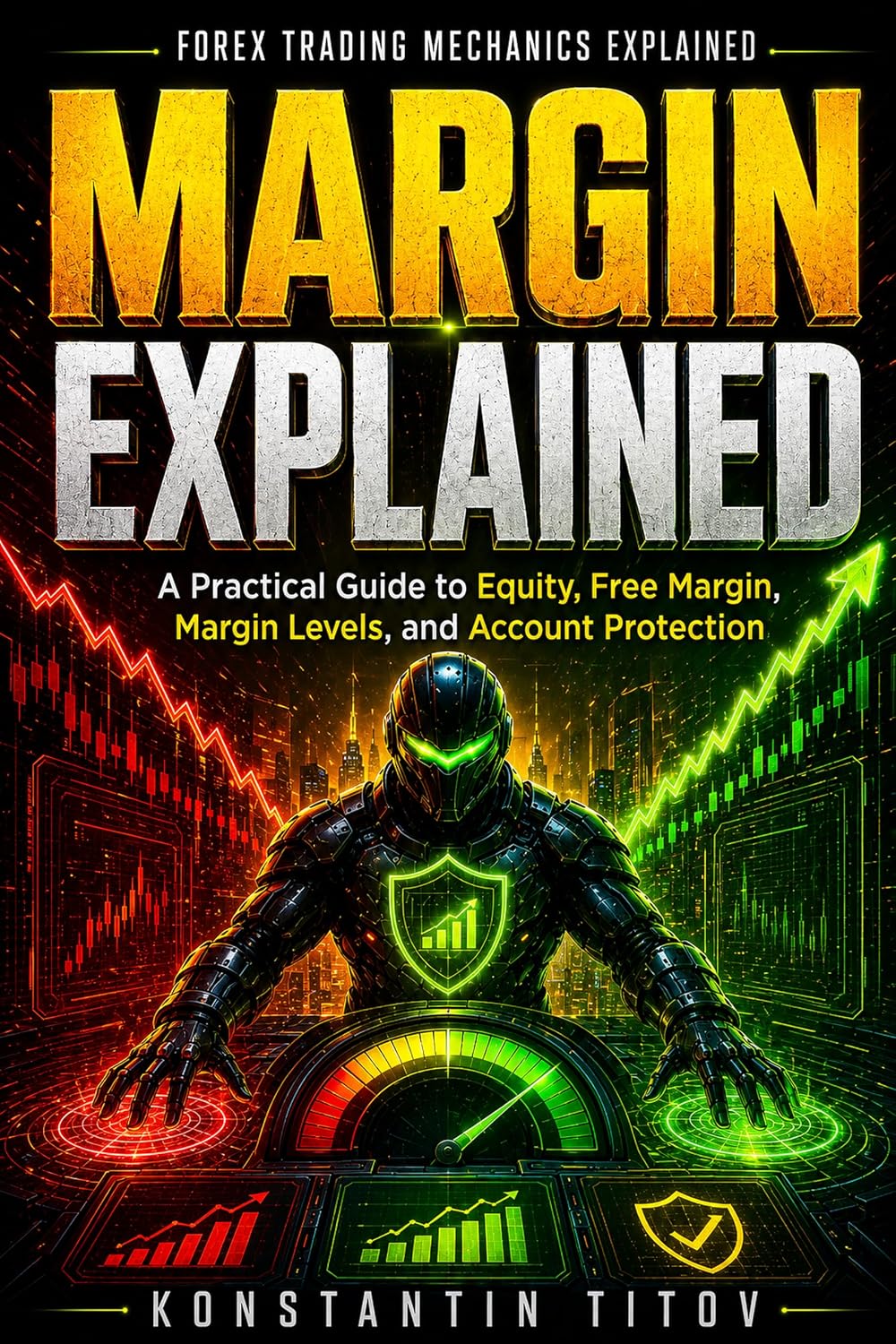
Book Description
A positive balance does not necessarily mean a leveraged trading account is healthy.
Open positions continuously change equity. Equity determines free margin. Free margin determines how much flexibility remains. Margin level measures the relationship between current account value and the collateral supporting open exposure. When that relationship weakens far enough, warnings, restrictions, stop-outs, and forced liquidation may follow.
Margin Explained offers a practical examination of the account mechanics that many Forex and CFD traders see on their platforms every day but do not fully understand. Rather than presenting margin as a simple entry requirement, the book shows how balance, equity, floating profit and loss, used margin, free margin, and margin level operate together as a dynamic system.
Through realistic scenarios and carefully worked numerical examples, readers follow accounts as market prices change, multiple positions compete for the same capital, volatility expands, spreads widen, and margin requirements shift. The book explains why margin is collateral rather than a trading fee, why unrealized losses already affect account strength, and why available capacity should not automatically be treated as permission to open another position.
Inside, readers will explore:
• The difference between balance and real-time equity
• How used margin and free margin are calculated
• Why margin level acts as an account pressure gauge
• What margin calls, stop-out levels, and forced liquidation mean
• How partial closures can change account figures
• Why several small or correlated positions may create hidden margin stress
• How volatility, market gaps, spread expansion, and changing broker requirements can reduce account flexibility
• Why hedged positions may still consume margin and create costs
• Common misconceptions about floating losses, available margin, and account safety
• A practical framework for monitoring account conditions before pressure becomes intervention
The book also clarifies an important distinction: a platform may allow a trade to be opened without confirming that the account can comfortably withstand the trade under changing market conditions. Broker thresholds, margin formulas, liquidation sequences, and negative balance protections may differ by jurisdiction, instrument, and account type. Understanding the applicable contract specifications is therefore part of responsible participation.
Margin Explained does not offer guaranteed protection, a universal safe margin percentage, or a method for eliminating trading losses. It is an educational guide to reading a leveraged account accurately, recognizing declining flexibility, and understanding the mechanical sequence that can transfer control from the trader to the platform.
Whether you are beginning your study of Forex, reviewing the figures shown in a trading terminal, or seeking a clearer understanding of collateral and liquidation mechanics, this book provides a structured foundation for interpreting what is happening inside the account while positions remain open.
Educational Notice: This book is provided for educational and informational purposes only. It does not constitute financial, investment, trading, legal, or tax advice. Forex, CFDs, and other leveraged products involve substantial risk and may not be suitable for every person.