Book Description
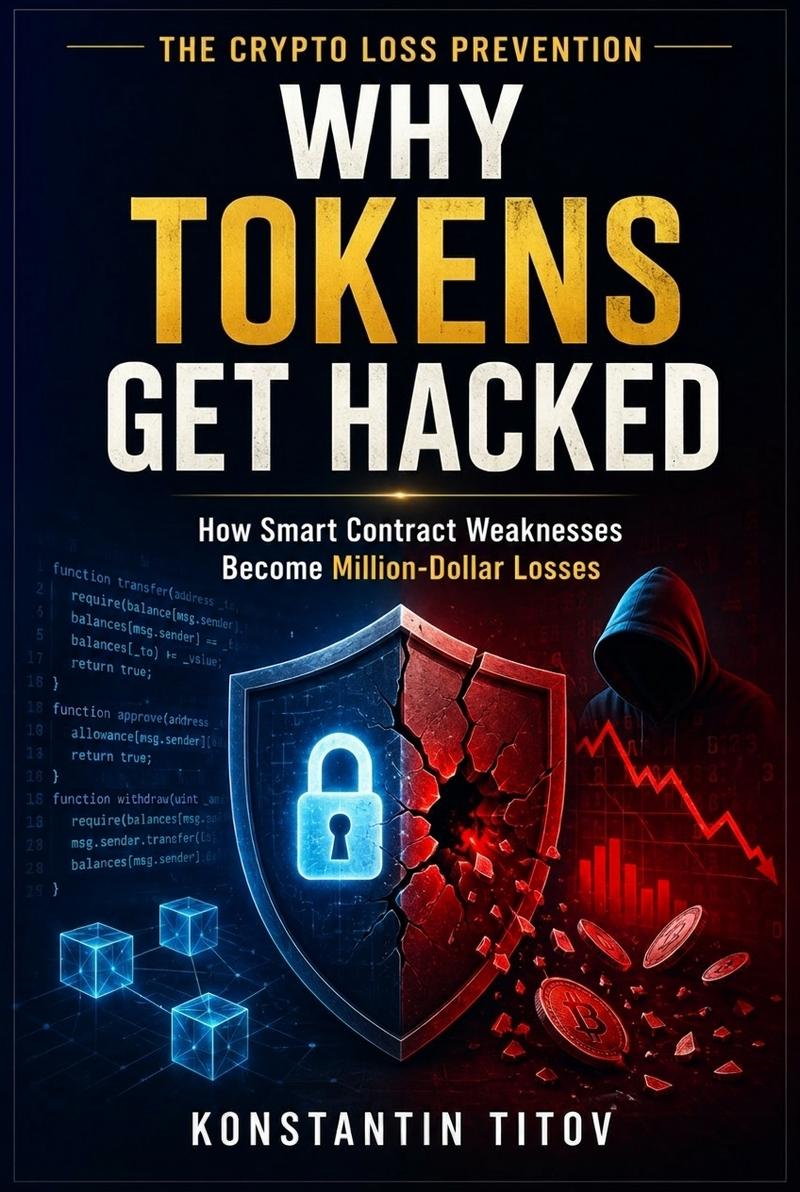
Why Tokens Get Hacked: How Smart Contract Weaknesses Become Million-Dollar Losses
The transaction that drains a treasury is never the beginning of the disaster.
It is the end.
In Why Tokens Get Hacked, author Konstantin Titov - whose body of work spans more than 300 books on law, compliance, anti-money laundering, security, and risk management - delivers a forensic examination of how digital asset projects collapse from within. Drawing on real-world incidents including the Ronin bridge breach, the Nomad bridge incident, Uranium Finance, Yam Finance, and other major cryptocurrency failures, this book dismantles the myth that crypto losses are primarily technical events.
The truth is more unsettling.
Most catastrophic losses begin as human decisions made in conference rooms, under deadline pressure, long before any attacker arrives.
The blockchain does not forgive. Once a smart contract is deployed, it executes exactly what was written - not what the team intended, not what the white paper promised, and not what the community believed. A missing permission check, a rushed audit skipped for budget reasons, a treasury wallet controlled by a single exhausted founder, an upgradeable contract without adequate safeguards - these are not exotic vulnerabilities. They are ordinary oversights that become extraordinary disasters when money, attention, and automation converge.
This book is written for professionals, investors, founders, entrepreneurs, compliance officers, legal advisors, auditors, and anyone who needs to understand blockchain risk without becoming a programmer. Investors learn to recognize the signals that separate disciplined teams from promotional machines. Founders discover why security is not a department that arrives after success, but the architecture of survival built before launch. Compliance professionals and advisors gain a shared framework for understanding how governance failures, operational weaknesses, and technical mistakes combine to create financial losses.
Titov guides readers through the complete anatomy of token failure: how blockchain transparency creates both accountability and risk, why certain projects emit signals of elevated risk, how seemingly minor contract weaknesses escalate into market-wide crises, and what genuine pre-launch discipline looks like when the countdown clock is ticking and the community is demanding speed. The final chapters provide a practical security checklist and a framework for treating investor protection as a product feature rather than an afterthought.
Inside this book, you will discover:
• Why many token losses begin long before the attack itself
• How public blockchains expose both strengths and weaknesses
• The most common governance and security failures in token projects
• Why audits matter and why audits alone are never enough
• How weak controls, rushed launches, and poor oversight increase risk
• The warning signs investors should recognize before committing capital
• Practical principles for building safer and more resilient projects
• A founder-focused security framework designed to reduce preventable losses
The crypto market rewards velocity loudly and punishes negligence permanently.
In a world where a single overlooked weakness can erase years of work, security is not a feature.
It is the foundation.
Why Tokens Get Hacked helps readers understand the risks before they become losses and the decisions that matter before the money disappears.