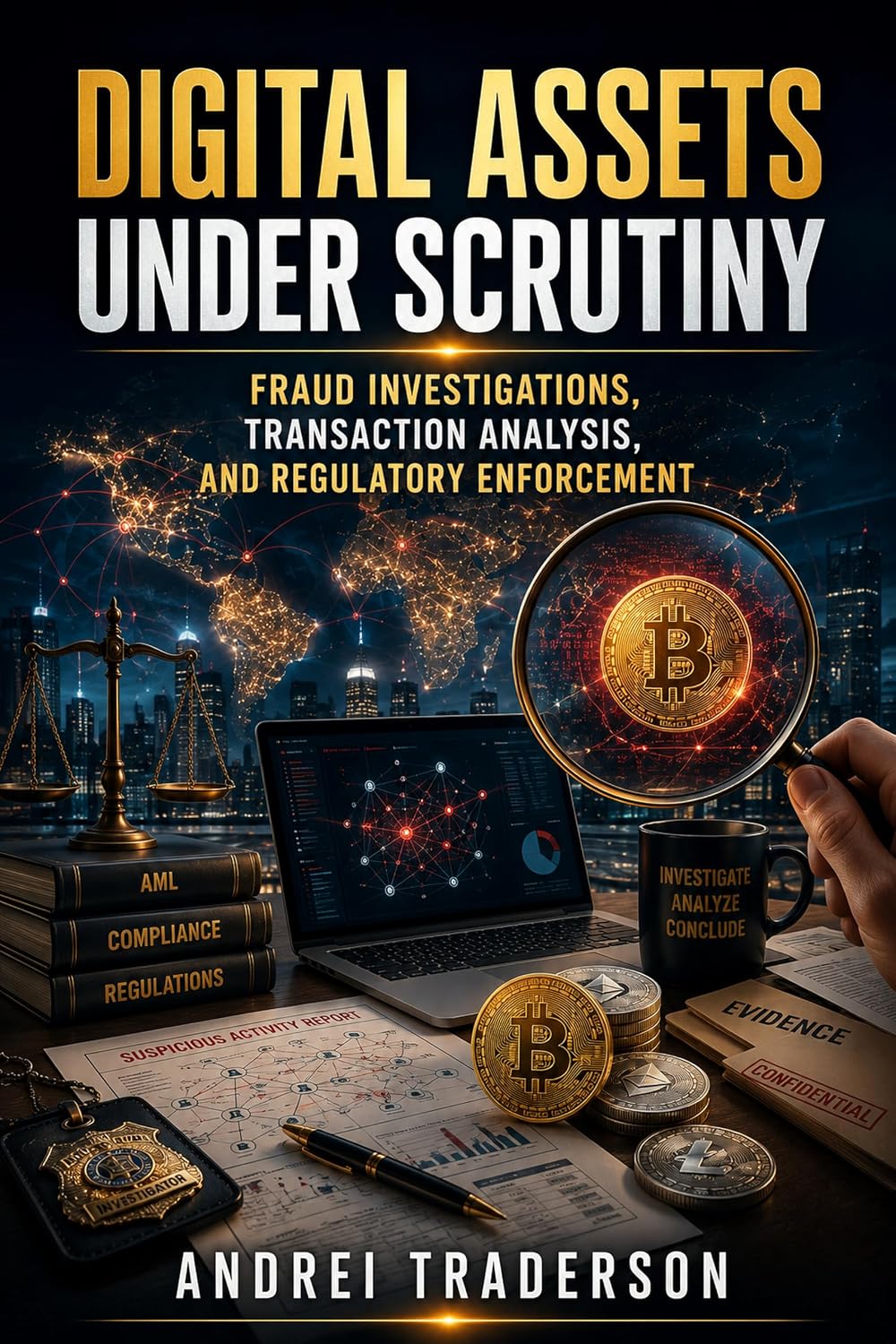
Book Description
Digital assets have changed the surface of financial crime, but not the investigator’s core question: does the movement of value make sense when tested against evidence, context, documentation, and control?
Digital Assets Under Scrutiny is a clear, practical examination of cryptocurrency-linked financial crime, blockchain evidence, transaction analysis, fraud typologies, money laundering risk, sanctions exposure, customer due diligence, attribution, regulatory expectations, and defensible case building.
This book does not treat crypto as automatically suspicious, and it does not treat blockchain data as automatic proof. Instead, it focuses on professional judgment: how to separate ledger facts from interpretation, how to avoid overreading transaction graphs, how to test customer explanations, and how to build conclusions that can survive internal review, regulatory scrutiny, and legal challenge.
Across realistic investigative scenarios, the book explores how digital assets may appear in ransomware payments, investment fraud, stablecoin transfers, self-hosted wallets, exchange deposits, offshore beneficiary payments, mixers, bridges, decentralized finance interactions, and high-risk wallet clusters. It also shows why labels, risk scores, and colorful analytics charts are not enough unless they are supported by customer records, source-of-funds evidence, beneficial ownership analysis, sanctions review, commercial rationale, and clear documentation.
Readers will find discussion of:
How digital assets enter modern financial crime investigations
Why blockchain transparency can both strengthen and distort analysis
Common crypto fraud and laundering typologies
Transaction analysis without premature attribution
Customer due diligence in digital asset cases
Stablecoin, exchange, mixer, bridge, and self-hosted wallet risks
Sanctions exposure and defensible escalation language
Red flags that require investigation rather than automatic conclusions
Case file discipline for compliance, AML, and enforcement environments
Written for compliance officers, AML professionals, fraud investigators, risk analysts, lawyers, regulators, financial crime specialists, and serious readers of digital asset enforcement, this book emphasizes precision over panic and evidence over assumptions.
The central message is simple: the blockchain can show where value moved, but it cannot explain motive, ownership, control, or criminal intent on its own. Strong digital asset investigations are built where on-chain evidence meets off-chain records and disciplined professional judgment.